Why the Best 3D Game Creators Probably Started with 2D


Many of the best-known 3D game creators made 2D games first. Shigeru Miyamoto's team made Super Mario Bros. and The Legend of Zelda in 2D years before Super Mario 64 and Ocarina of Time. id Software shipped the 2D Commander Keen games before Wolfenstein 3D and Doom. Grand Theft Auto began as a top-down 2D game before Grand Theft Auto III moved the series into 3D. The pattern makes sense: 2D lets you learn input, rules, state and feedback without also fighting cameras, models and lighting. If you're starting out on iPad, a small 2D game is a strong first step.
Why 2D is a good place to start
Game history doesn't prove you must start in 2D. Hardware shaped those early games too. The reason the path still works today is about scope. A 2D game has fewer moving parts, so you spend more of your time on the rules your player will feel.
Every game, flat or deep, needs the same core decisions:
- the event that starts an action
- the values the game remembers
- the condition that changes the outcome
- the feedback the player receives
- the test that tells you whether it works
A 2D project lets you practice those decisions quickly. When you move to 3D later, the coordinate system and asset pipeline change, but those habits carry over.
What changes between 2D and 3D
A 2D game places Objects on horizontal and vertical axes. Art is usually flat Graphics, illustrations, tiles and frame animation. The camera may scroll, but the game logic sits on a flat plane.
A 3D game adds depth. The work can include 3D models, materials, lighting, a movable camera and movement across three axes. That extra dimension affects art production, level design, navigation, collision and performance.
| Decision factor | 2D project | 3D project |
|---|---|---|
| Player movement | Left, right, up, down, lanes, grids or fixed screens | Movement through depth with a controllable camera |
| Art workflow | Graphics, frame animation, tiles and UI | Models, materials, rigs, textures and 3D animation |
| Collision design | Shapes and surfaces on a 2D plane | Volumes and movement through three axes |
| Camera | Fixed, scrolling or following on a plane | Orbiting, first-person or perspective navigation |
| Lighting | Often drawn into the art | Usually set up in the scene |
| First prototype | One Scene and one complete mechanic | A test of camera, scale, navigation and spatial readability |
These are common workflows, not hard limits. A 2D game can have deep systems, and a 3D prototype can be small. Treat the choice as a decision about this project's scope. It says nothing about how skilled you are.
Decide from the mechanic
Pick a dimension based on what the player does. Write the main action in one sentence, then ask whether depth is required.
- "Tap to jump over an obstacle" works in 2D.
- "Drag pieces onto matching shapes" works in 2D.
- "Explore rooms and choose dialogue responses" works in 2D.
- "Rotate a camera and walk around a sculpture" needs 3D.
- "Aim and move through a space with vertical depth" needs 3D.
Choose 3D first when moving toward and away from the camera, exploring a 3D environment, lighting, animated 3D models or physics across three axes are central to the idea. Check the engine's current documentation and system requirements before you commit. Desktop engines such as Unity have their own editor requirements, so read the current Unity system requirements rather than assuming the full editor runs on iPad.
hyperPad is a visual 2D game engine. It's a good fit for building and testing the 2D version of your idea directly on iPad, with Scenes, Objects, Graphics, Attributes, physics and Behaviors.
What a 2D prototype teaches you
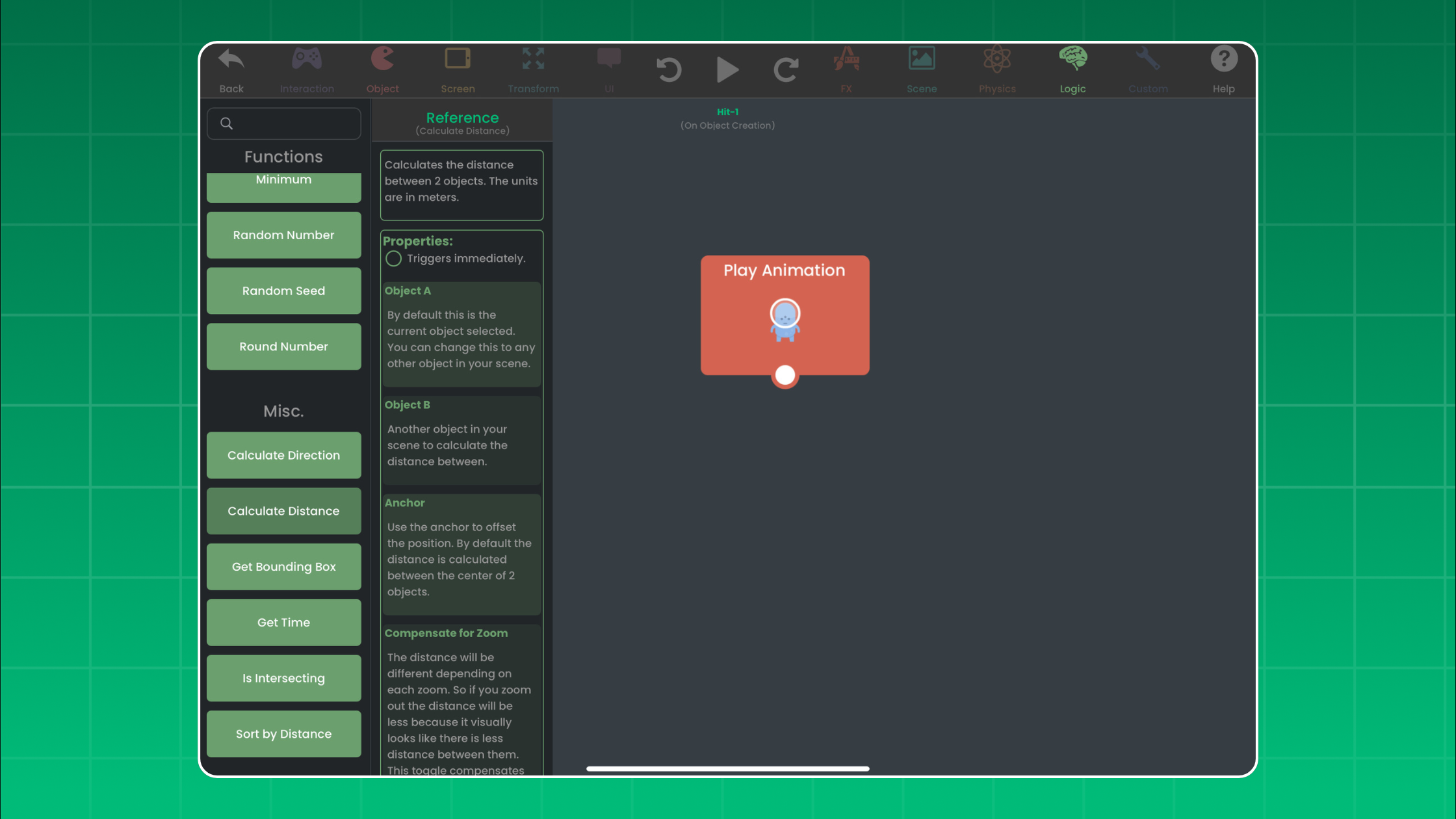
In hyperPad, you make game logic with Behaviors: you connect actions and events to create a flowchart of your game's logic. The Behavior Interface Overview explains how they connect in the Behavior Editor.
A one-button platform mechanic covers a lot of ground:
- input with Started Touching
- movement with Set Velocity
- landing and hazards with Collision Event
- state with Object Attributes
- decisions with If
- feedback with a sound, animation, label or particle effect
A coin game teaches the same ideas in a different shape. Put a player Object, five coin Objects and a score label in one Scene. When the player collides with a coin, add 1 to a score Attribute on a controller Object, update the label, and disable the coin. That's input, collision, state, feedback and a win condition, with no 3D assets required.
Build a small 2D test on iPad
Use one Scene. Add a player Object, a platform, one obstacle and a restart button.
Set up this loop:
- Started Touching detects the jump input.
- If checks whether the player is allowed to jump.
- Set Velocity moves the player upward.
- Collision Event detects a landing or an obstacle hit.
- Set Attribute updates values such as
canJumporroundState. - The Scene shows a clear success or failure result.
- The restart button restores the same starting state.
Run the Project after each connection. If the jump feels wrong, adjust one value and test again. Wait to add another level until the input, landing, failure and restart all work.
Bring your own art into the test
Draw a player, an obstacle and a background in your favorite iPad art app, such as Procreate. Export each element as a separate PNG when it needs transparency. Follow Importing Assets to bring the files into the Project, and use the Asset Library to organize Graphics, animations, audio and fonts.
Then test each Graphic in the running Scene:
- Can the player read it at the intended size?
- Does its collision shape match what the player sees?
- Does it stand out from the background?
- Does each animation show the game state clearly?
- Do you have the right to use every imported file?
A detailed Graphic won't help if the jump direction or collision boundary is unclear. Get the mechanic working with plain shapes first.
Know when 2D is the finished direction
You don't have to move to 3D after you learn the basics. Plenty of complete games stay 2D: card games, platformers, puzzle games, visual stories, rhythm games and top-down action games. For many of them, adding depth would change the game rather than improve it.
Move to a 3D engine when your tested design depends on 3D space. Compare current tools on platform support, camera and lighting workflow, asset pipeline, deployment requirements and the hardware you have. If you're weighing options, A Comparative Analysis of Top Game Development Software lays out where each engine runs.
Your next step
Build one loop in hyperPad this week: one action, one challenge, one result and one restart. Ask a friend to play it without instructions. If they can find the player, understand the collisions and restart on their own, you've learned the same fundamentals those 3D creators started with.