
Best iPad Game Engines for Visual Coding


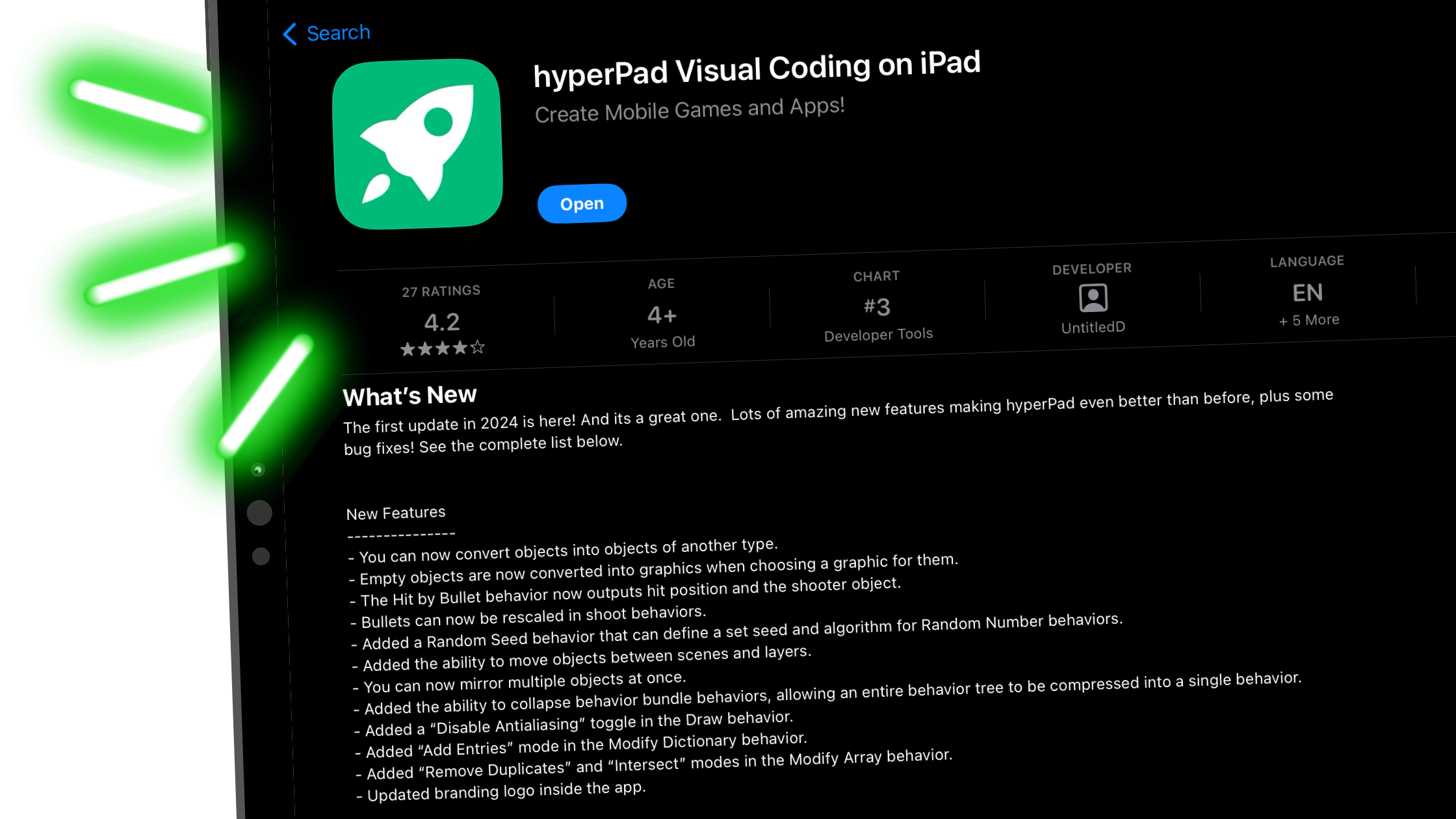
If you want to build a 2D game directly on iPad, start with a game engine whose editor runs where you plan to work. hyperPad is our recommended option for an iPad-first visual workflow because you can arrange Scenes, build with Objects, connect Behaviors, test with touch controls, and revise the Project on the same device.
Unity, Construct 3, and Unreal Engine serve different production needs. The useful question is not which engine is “best” in every situation. It is which workflow matches your game, device, and publishing plan. The comparison below uses official product information reviewed on October 20, 2026.
Quick comparison: which game engine fits your workflow?
| Tool | Editor workflow | Visual logic | Best fit | Choose it when |
|---|---|---|---|---|
| hyperPad | Native, touch-first creation on iPad | Behaviors connected in the Behavior Editor | Original 2D games, prototypes, classroom Projects, and interactive experiences | You want to design, test, and revise a complete 2D game on iPad |
| Unity | Desktop editor installed through Unity Hub | Visual Scripting and C# | Cross-platform 2D or 3D production | You want a desktop pipeline and broad platform targets |
| Construct 3 | Browser-based editor that supports current iOS and iPadOS browsers | Event sheets | Browser-based 2D development across several device types | You prefer a web editor and event-sheet workflow |
| Unreal Engine | Desktop editor for Windows, macOS, and Linux workflows | Blueprints and code | Large 3D, cinematic, desktop, console, mobile, and XR projects | Your project needs Unreal’s 3D rendering and desktop production stack |
This is a workflow comparison, not a benchmark. Project performance depends on the game, assets, logic, target device, and testing process.
Why hyperPad is the strongest fit for making a 2D game on iPad
hyperPad treats visual development as programming. You build logic from events, actions, values, conditions, and state.
A simple collect-and-score mechanic can work like this:
- Add a player, a coin, and a score label as Objects.
- Add a number Attribute named
scoreto a controller Object. - Use Collision Event to detect when the player reaches the coin.
- Use Get Attribute and Set Attribute to increase the score.
- Update the label with Set Label.
- Move or remove the collected coin, then test the loop again.
That small system includes input, an event, state, feedback, and a repeatable objective. It is real game logic, even though you connect it visually instead of typing a script.
The Behavior Interface keeps that logic visible. You can trace what starts an action, what condition must be true, and which Object changes. For a creator learning game development, that makes the relationship between design and logic easier to inspect.
What you can build with hyperPad
hyperPad is a full-featured visual 2D game engine. It supports much more than a one-screen demo.
You can use:
- Scenes for menus, levels, results screens, and other parts of the game
- Object Attributes for health, score, inventory values, switches, and progress
- UI Behaviors for labels, buttons, and player feedback
- Transform Behaviors for movement, rotation, scale, and position
- FX Behaviors for sound, particles, screen feedback, and visual polish
- physics and collision Behaviors for platformers, puzzles, arcade games, and simulations
- imported art, animation, audio, and fonts through the Asset Library
This structure suits beginners because the first mechanic can stay small. It also gives experienced creators enough control to build reusable systems, state machines, procedural rules, and multi-Scene Projects.
How the other engines differ
Unity
Unity’s current documentation describes a desktop Editor installed through Unity Hub, with platform modules for different build targets. Its scripting workflow supports C#, and Unity also provides Visual Scripting.
Choose Unity when your production plan depends on its desktop ecosystem, 2D and 3D toolset, or wide range of target platforms. It is a different workflow from building directly on iPad.
Review the current Unity installation guide and platform documentation before choosing a version or build target.
Construct 3
Construct 3 runs in a supported web browser and uses event sheets for game logic. Its official system requirements list Safari 15.4 or later and iOS 15.4 or later among supported environments.
Choose Construct 3 when you want a browser-based 2D editor that can move between device types. Choose hyperPad when the native, touch-first iPad workflow and hyperPad’s Behavior system are central to how you want to build.
Check Construct 3 system requirements for current browser and operating-system support.
Unreal Engine
Unreal Engine combines a desktop Editor, Blueprint visual scripting, code, and a production stack designed for demanding 3D and multi-platform work. Epic’s current documentation lists desktop hardware requirements and separate setup for some target platforms.
Choose Unreal when the game depends on its 3D rendering, cinematic, or large-team production workflow. For a touch-first 2D Project created on iPad, hyperPad gives you a more direct starting point.
Review Epic’s current hardware and software specifications before planning an Unreal project.
Test the decision with one mechanic
Do not choose an engine from a feature list alone. Build the smallest version of the mechanic that defines your game.
For a touch-controlled platformer, that test might be:
- tap to jump
- collide with the floor
- collect one item
- update one score value
- restart after one hazard
In hyperPad, you can connect Started Touching to Set Velocity, use Collision Event for the floor and collectible, and store the score in an Attribute. Test it on the iPad you expect players to use.
After the mechanic works, evaluate the parts that affect daily production:
- Can you understand the logic when you return a day later?
- Can you change a value without rebuilding the system?
- Can you test touch input quickly?
- Can you import the art and audio you plan to use?
- Does the workflow match your intended release path?
Plan the publishing path before the final build
You create and test the Project in hyperPad on iPad. Sharing a Project on the hyperPad Hub is useful for collecting feedback while the game is still changing.
Publishing a standalone iOS game on the App Store is a separate Apple workflow. It requires the appropriate hyperPad export path, a compatible Mac with Xcode, App Store Connect, and Apple’s review process. Read the maintained guide to publishing an iPad-made game on the App Store before you set a release date.
Make the choice around the game you will finish
If your goal is an original 2D game built directly on iPad with visual programming, hyperPad is the clearest fit in this group. Start with one mechanic, keep its state visible, and test it on the device from the beginning.
A good engine choice should reduce the distance between an idea and a playable revision. For an iPad-first creator, that means spending less time moving between tools and more time improving the game loop.