How to Make AI-Powered Games on iPad with No Coding in hyperPad

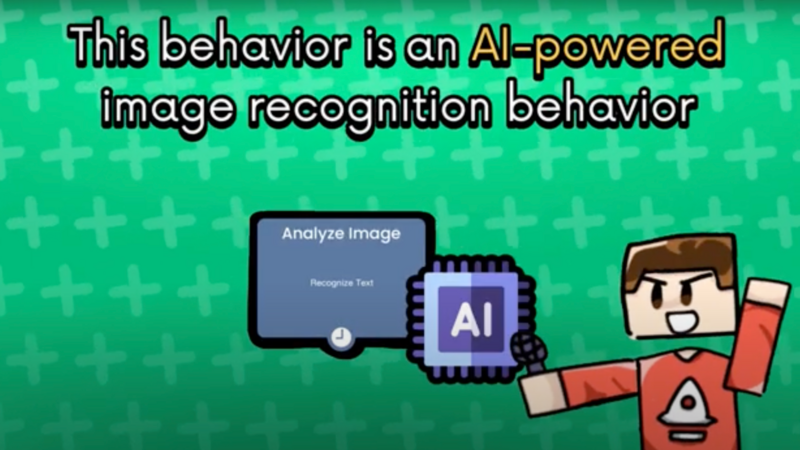
You can make AI-powered games on iPad with no coding by using hyperPad's Analyze Image Behavior. It uses on-device machine learning to look for text, barcodes, animals, or faces in an image, and your game reacts to what it finds. You connect it to other Behaviors the same way you connect a jump or a score. The analysis runs on the device, so the selected image doesn't need to go to an online AI service.
This tutorial builds one AI mechanic: the player chooses an image, hyperPad looks for text, and the Project draws labeled boxes over the detected regions. Then you'll turn that result into a game rule. After that, you'll give an enemy simple rule-based AI with Behaviors and see where AI tools can help you plan, draw and write your game.
What the Project will do
The finished flow is:
- The player taps a button.
- Load Image opens the image picker.
- Set Graphic displays the selected image.
- Analyze Image checks it for text.
- A loop reads the returned results and bounding boxes.
- The Project places a label over each detected region.
The AI does the recognition. You still decide what each result means for the game, and you connect it to state, feedback, and rules with Behaviors.
Build the image-analysis flow
1. Create the interface
Add a button or label that starts the mechanic. Add a second Object that will display the selected image. Keep the image Object hidden until a Graphic has loaded.
Use relative positioning if the interface must adapt to different screen sizes. The Screen Behaviors documentation explains tools that work with screen coordinates and layout.
2. Let the player choose an image
Connect the start control to Load Image. After the player selects an image, pass its output to Set Graphic so the display Object shows the same image the Project will analyze.
Treat cancellation as a normal path. If no image comes back, keep the display hidden and let the player try again.
3. Analyze the image
Connect Analyze Image after the Graphic loads. Choose the analysis type your mechanic needs. For this example, use text recognition.
The Behavior returns detected content and location data. Those outputs are values the next Behaviors can read. The game's response is up to you.
4. Display the results
Loop through the returned entries. For each result:
- create or reveal a marker Object
- position it using the returned bounding box
- set a label to the detected text
- keep the marker attached to the displayed image
The Behavior Interface Overview explains how outputs feed connected Behaviors. If you need to store or compare the detected value, use Object Attributes.
Turn recognition into an AI game mechanic
Detection becomes gameplay when you attach a rule to it. Start with one:
- Word hunt: award a point when the detected text matches a target word.
- Barcode puzzle: use a recognized barcode value as a key.
- Nature journal: ask the player to review an animal result and add it to a collection.
- Photo challenge: compare a result with the current objective, then show success or a retry message.
Let the player confirm results when a wrong guess would frustrate them. A nature journal, for example, can ask the player to accept or reject a suggested label.
Test the mechanic properly
Use at least five images that should succeed and five that shouldn't. Include small text, rotated text, low contrast, busy backgrounds, and an image with no target content. Results vary with lighting, angle, and image quality, so your own sample set matters.
Check:
- what happens when the picker is cancelled
- what happens when nothing is detected
- whether boxes align after the image is scaled
- whether duplicate results create duplicate rewards
- whether the player can retry
- whether the Project gives a clear success or failure message
This test set tells you whether the mechanic is reliable enough for the way your game uses it.
Watch the workflow
Watch the Analyze Image workflow on YouTube. Follow the video alongside the steps above.
Give an enemy simple AI with Behaviors
In many games, "AI" means a character that seems to make its own decisions. You can build that with Behaviors alone. A basic enemy needs one Attribute that stores its current state and a few rules that change it:
- Patrol. The enemy moves between two points with Move to Point.
- Chase. When the player comes close, Set Attribute switches the state, and Move to Object sends the enemy toward the player.
- Give up. When the player gets far enough away, the state switches back and the enemy returns to its patrol.
Use a Timer to check the distance every fraction of a second, and an If Behavior to pick the action that matches the current state. Tune the chase distance and speed until the enemy feels fair. A small delay before it starts chasing gives the player a moment to react.
Once one enemy works, add variety by changing its values. A guard might chase for a short distance, while a hunter keeps following. Each one uses the same states with different numbers.
Use AI tools to plan, draw and write
AI can also help outside the game itself:
- Planning. Describe a mechanic to an AI assistant and ask it to break the rule into events, conditions and actions. AI-Powered Game Logic: Plan hyperPad Behaviors with AI shows how to turn that plan into Behaviors.
- Art. Generate concept art or first-pass characters, clean them up in an iPad art app, and import them as Graphics through the Asset Library. How to use AI to generate game art covers the workflow.
- Writing. Draft dialogue, item descriptions or hint text with a writing assistant, then edit it in your own voice before you put it in a Label.
Check each tool's terms before you use its output in a game you plan to Publish or Export. You still build the game logic yourself by connecting Behaviors, so you understand how every rule works.
Your next step
Build your first AI-powered game: one analysis type, one rule and one clear response, tested with your own images. Then add a patrolling enemy that chases the player when they get close. For a wider look at where AI shows up across the industry, from enemies to level design, read AI everywhere in game development.