Visual Game Development for Middle School Students on iPad

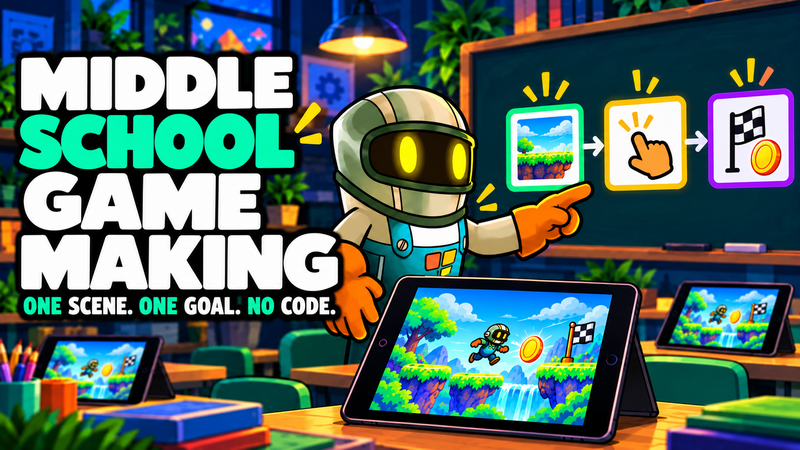
A useful middle-school game-development tool should let students build a real rule, inspect how it works, test it, and explain what they changed. In hyperPad, students use visual Behaviors to work with events, actions, conditions, values, input, and state directly on iPad.
The strongest first activity is a small game loop that can be completed and assessed in a few sessions.
Project: collect and sort
Students build one Scene with a player, six falling Objects, two collection zones, a score, and a timer. Three Objects belong in each zone.
The rule:
Move each Object to the correct zone before time runs out. Correct choices add a point. Incorrect choices return the Object and show feedback.
This project teaches more than dragging. Students must represent categories, store score, compare conditions, and debug incorrect results.
What students learn
| Concept | Student decision | Visible evidence |
|---|---|---|
| Event | What starts the rule? | A touch, drag, drop, or collision triggers the chain |
| Attribute | What must the game remember? | Each Object stores its category; the Project stores score |
| Condition | How does the game decide? | An If Behavior compares the Object category with the zone |
| Action | What happens next? | Score changes, feedback appears, and the Object moves |
| Debugging | Why did the result differ? | The student identifies the wrong Object, value, or connection |
A manageable classroom sequence
Session 1: define and build
Students choose a category pair, sketch the Objects, create one Scene, and place the two zones. Use placeholder art if drawing would consume the session.
Session 2: connect one Object
Build and test one correct and incorrect path. The Behavior Interface Overview, Object Attributes, and If documentation support the logic.
Session 3: expand and test
Duplicate the tested pattern, change each Object's category value, add score and time, then trade iPads for peer testing.
Session 4: explain and revise
Students submit one screenshot or diagram of the Behavior flow, a short explanation of the stored state, one bug they found, and one revision based on a peer observation.
Assess the process, not visual polish
A simple rubric can score:
- the game states its objective
- the input works
- correct and incorrect paths differ
- score changes accurately
- the timer leads to an ending
- restart restores the initial state
- the student can explain one Behavior chain
- the revision responds to observed play
Do not grade expensive artwork or prior game experience as programming skill.
Set classroom boundaries
Confirm device compatibility and account requirements before the lesson. Decide whether students will work individually or in pairs and whether Projects will stay local.
Hub sharing and public community participation require a separate decision about accounts, school policy, moderation, and student privacy. They are not required for the classroom mechanic.
Choose the tool by the lesson
hyperPad is a strong fit when the lesson needs native iPad creation, visual game logic, and immediate testing. The tool does not guarantee a learning outcome. The evidence comes from the student's working Project, explanation, test record, and revision.